
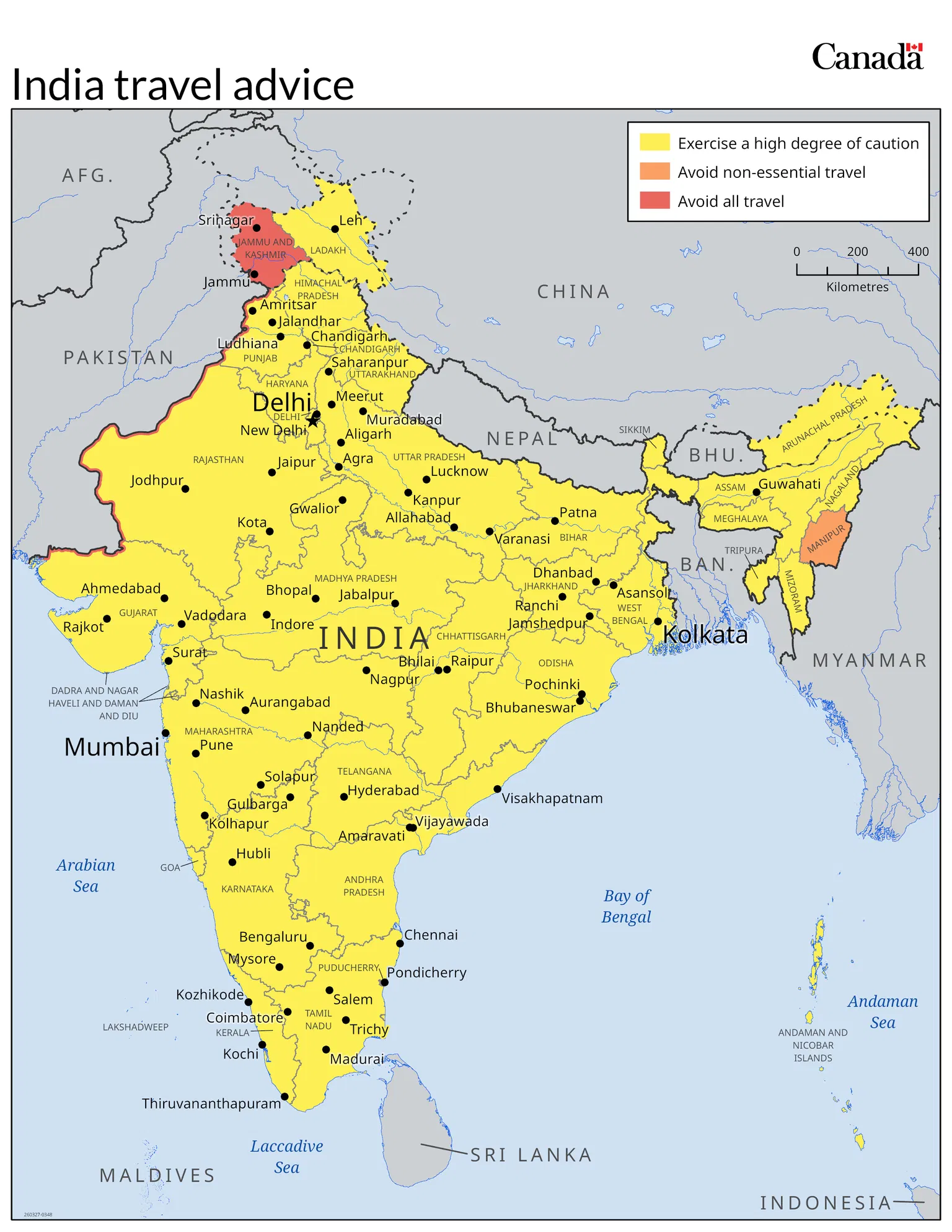
The Canadian government has issued an updated Level 3 travel advisory warning citizens to avoid non-essential travel to Manipur, India's northeastern state, as ethnic violence between Meitei and Kuki communities continues to claim lives and trigger widespread unrest. The warning comes amid fresh clashes that saw a bomb blast kill two children and prompt police firing amid massive protests, leading to internet shutdowns across five districts and curfews in four others.
Canada's Travel Warning: What You Need to Know
According to the official Government of Canada travel advisory updated on March 27, 2026, Manipur carries a Level 3 "avoid non-essential travel" designation due to "the risk of terrorism and insurgency." The advisory explicitly warns that several extremist and insurgent groups are active in the state, regularly targeting local government and security forces, and that ethnic tensions can lead to conflict and civil unrest. The Canadian government notes that clashes have resulted in casualties, disruptions to traffic and public transportation, and district curfews.
The United States has taken an even stricter stance, with the State Department issuing a Level 4 "Do Not Travel" advisory for Manipur. The U.S. warning states: "Do not travel to Manipur due to the threat of violence and crime. Ongoing ethnic-based conflict has resulted in reports of extensive violence and community displacement." This places Manipur among the highest-risk destinations worldwide alongside conflict zones like Afghanistan and Syria.
From 2023 to Today: The Manipur Violence Timeline
The current crisis traces back to May 2023 when ethnic violence first erupted between the majority Meitei community, concentrated in the Imphal Valley, and the Kuki tribal groups from the surrounding hills. What began as protests over land rights and political representation quickly escalated into armed clashes, arson attacks, and mass displacement. According to Wikipedia's documentation of the 2023–2025 Manipur violence, the conflict has resulted in hundreds of deaths and displaced over 70,000 people.
The violence has followed a cyclical pattern of relative calm punctuated by intense flare-ups. The latest escalation began on April 7, 2026, when a pre-dawn bomb blast in Bishnupur district killed two children and injured their mother. As reported by The Times of India, the attack sparked massive protests across Manipur's Imphal Valley, with demonstrators blocking roads and clashing with security forces. Police resorted to firing tear gas and warning shots to disperse crowds, while authorities imposed internet shutdowns in five districts for 72 hours.
Why Manipur Remains a High-Risk Destination
Several factors contribute to Manipur's persistent security challenges. The state's location in India's volatile northeast—bordering Myanmar—has long made it susceptible to insurgent activity. Multiple armed groups operate in the region, some seeking greater autonomy or independence. Additionally, deep-seated ethnic tensions between the Meitei and Kuki communities have been exacerbated by competition over land, resources, and political power.
Travel security experts note that the situation is particularly dangerous for foreigners because violence can erupt spontaneously, and government security forces may be unable to provide adequate protection. The Canadian advisory specifically warns that while tourists are not usually targeted, bystanders could be affected by attacks on security forces or government installations. The advisory also highlights risks of kidnapping, armed robbery, and being caught in crossfire during clashes.
Latest Developments: Internet Shutdowns and Curfews
As of April 7, 2026, Manipur remains under severe restrictions. The Hindu reported that Chief Minister Khemchand chaired a high-level security meeting and ordered internet suspension in five valley districts for three days. According to local media, curfews have been imposed in four districts—Bishnupur, Churachandpur, Kangpokpi, and Tengnoupal—following the latest violence. Security forces have been placed on high alert, with additional paramilitary troops deployed to sensitive areas.
The economic impact has been severe, with markets, schools, and government offices remaining closed in affected areas. Transportation networks have been disrupted, and The Times of India reported that the Imphal-Dimapur highway—a crucial supply route—was blocked by protesters for several hours before security forces cleared it. These developments directly impact the Canadian advisory's warning about disruptions to traffic and public transportation.
What Happens Next: The Road Ahead for Manipur
Analysts suggest the immediate outlook for Manipur remains bleak. With neither ethnic community showing willingness to compromise and political solutions stalled, violence is likely to continue in cycles. The Canadian and U.S. travel advisories are expected to remain in place indefinitely until substantial security improvements occur. Local journalists report that both Meitei and Kuki armed groups have been accumulating weapons, suggesting the conflict could escalate further.
For travelers, this means Manipur should be considered off-limits for the foreseeable future. Even areas previously considered relatively safe, such as the state capital Imphal, have experienced violent protests and security crackdowns. Those with essential reasons to visit should register with the Registration of Canadians Abroad service and develop comprehensive security plans, including secure accommodations, reliable local contacts, and emergency evacuation options.
Key Takeaways for Travelers
• Avoid all travel to Manipur: Both Canada and the U.S. advise against travel to the state, with Canada recommending avoiding non-essential travel and the U.S. saying "Do Not Travel."
• Monitor advisories regularly: The situation can change rapidly; check travel.gc.ca and travel.state.gov for updates.
• Have contingency plans: If you must travel, register with authorities, maintain communication channels, and identify evacuation routes.
• Exercise extreme caution elsewhere in India: Canada's advisory also recommends avoiding all travel to Jammu and Kashmir and areas within 10 km of the Pakistan border.
• Consider travel insurance: Many policies exclude coverage for destinations under government travel warnings—verify coverage before departure.
The Manipur crisis serves as a sobering reminder that even destinations with rich cultural heritage and natural beauty can become danger zones when ethnic and political tensions explode. For now, travelers should heed government warnings and explore India's many safer regions instead.