
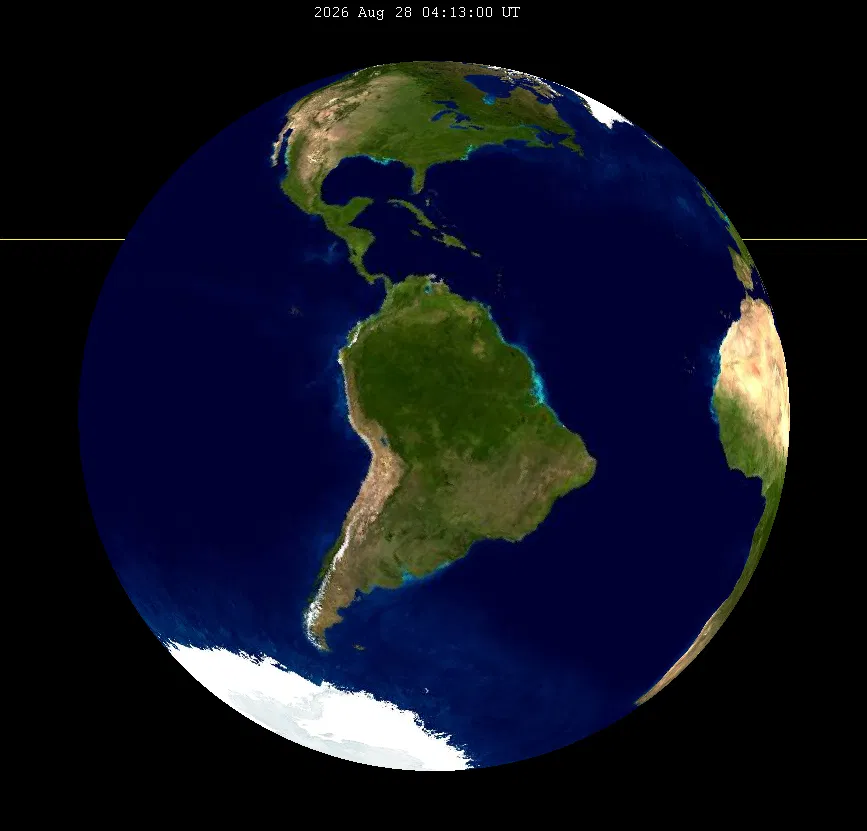
The Moon is about to take its turn. Just two weeks after the total solar eclipse of August 12, 2026 drew enormous crowds across Greenland, Iceland, and Spain—where authorities deployed roughly 24,000 police officers to manage the influx of visitors—a deep partial lunar eclipse will sweep across the night sky on Friday, August 28, 2026. Best of all, this one needs no protective glasses and no single-file path of totality: anyone on the night side of Earth can simply look up.
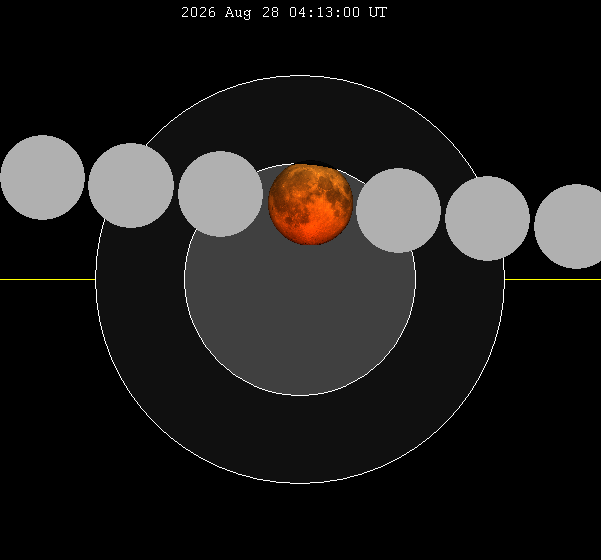
According to NASA's eclipse catalog, the Moon reaches greatest eclipse at 04:13 Universal Time on August 28, sliding so deeply into Earth's umbra—the darkest part of its shadow—that nearly 93% of the lunar disk will darken into a dim, coppery "almost total" Moon. Astronomers log this event as Saros 138, and it closes out a rare run of four consecutive deep lunar eclipses that began with total eclipses in March 2025, September 2025, and March 2026.
The Deepest Partial Eclipse You'll See for Years
What makes this eclipse stand out is its depth. NASA lists the umbral magnitude at 0.9299, meaning about 93% of the Moon's diameter will sit inside Earth's dark inner shadow at maximum. Visually, that translates to a Moon that looks almost fully eclipsed: the shadowed portion glows a dim, rusty red while a bright sliver clings to the limb. The partial (umbral) phase lasts a generous 3 hours and 18 minutes, and the entire event—including the subtle penumbral stages—stretches past 5 hours and 38 minutes, giving photographers and casual observers plenty of time to enjoy the show.
The eclipse also arrives about six days after the Moon reaches apogee, its farthest point from Earth, on August 22, so the Moon will appear slightly smaller than average in the sky. It's a fitting finale to what astronomers call an "almost tetrad"—four lunar eclipses in a row, three of them total, that began in March 2025.
Eclipse Timing: When to Look Up, In Your Time Zone
The eclipse unfolds over several hours in Universal Time. Per NASA, the Moon first touches the faint penumbral shadow at 01:24 UT, enters the dark umbra at 02:34 UT, reaches greatest eclipse at 04:13 UT, exits the umbra at 05:52 UT, and leaves the penumbra at 07:02 UT. Here's how that translates for viewers in key regions:
- Pacific (PDT): partial begins 7:34 p.m., maximum 9:13 p.m., ends 10:52 p.m. (Aug 27)
- Mountain (MDT): begins 8:34 p.m., maximum 10:13 p.m., ends 11:52 p.m. (Aug 27)
- Central (CDT): begins 9:34 p.m., maximum 11:13 p.m., ends 12:52 a.m. (Aug 28)
- Eastern (EDT): begins 10:34 p.m., maximum 12:13 a.m., ends 1:52 a.m. (Aug 28)
Across South America—where the Moon sits nearly overhead at maximum, over the Brazil–Bolivia border region—the eclipse peaks in the early hours of August 28. In Rio de Janeiro and Buenos Aires, the partial phase runs from about 11:34 p.m. on August 27 to 2:52 a.m. on August 28, with maximum around 1:13 a.m. Europe and Africa, meanwhile, catch the eclipse at moonset: in Madrid, Paris, and Rome (CEST), the partial phase begins around 4:34 a.m. on August 28 and peaks at 6:13 a.m., just as the eclipsed Moon sinks toward the western horizon—a dramatic "setting eclipse" scene for early risers and photographers.
Where to Travel for the Best View
Because a lunar eclipse is visible from half the planet at once, you don't need to chase a narrow path—but some destinations deliver noticeably better conditions. NASA's visibility data confirms the eclipse is completely visible across North and South America, making the Americas the best bet for catching the entire event from beginning to end. In Europe, Africa, and the Middle East, viewers see the Moon set while still partially eclipsed.
If you caught August 12's total solar eclipse in Iceland or Spain—or missed the crowds—this lunar eclipse is the perfect follow-up. The two events belong to the same eclipse season, which is why they fall just over two weeks apart. Among prime viewing ideas: high-desert and national-park locations in the western United States such as Utah, Arizona, and California's Sierra for dry, clear August skies; Chile's Atacama Desert for some of the darkest skies on Earth; high-altitude Andean towns in Peru and Bolivia, where the Moon rides almost directly overhead; and the islands and coasts of the Caribbean and Brazil. In Europe, Spain and Portugal—already eclipse-central this month—remain appealing for a moonset eclipse framed by the Atlantic horizon.
Fresh Off the August 12 Total Eclipse, All Eyes Turn to the Moon
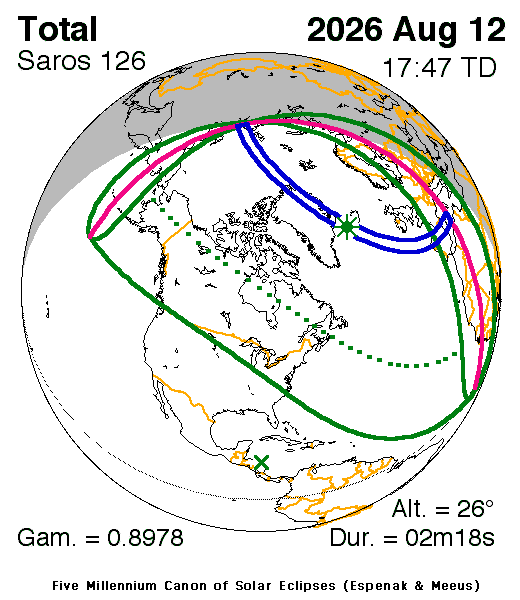
The August 28 eclipse comes on the heels of one of the year's biggest travel events. On August 12, a total solar eclipse carved a 294-kilometer-wide path of totality across Greenland and Iceland before sweeping over northern Spain and the Balearic Islands, with totality lasting up to 2 minutes and 18 seconds. Spain mobilized roughly 24,000 police officers to handle the crowds, and NASA flew high-altitude WB-57 research aircraft over the North Atlantic near Iceland to extend its view of the Sun's corona. Now, with that spectacle behind us, the Moon offers a quieter—but no less memorable—show that millions more people can see.
How to Watch and Photograph the Eclipse
No special equipment is required. Unlike a solar eclipse, a lunar eclipse is completely safe to view directly with the naked eye, binoculars, or a telescope. Binoculars reveal the curve of Earth's shadow creeping across the lunar surface and the rust-red color caused by sunlight filtering through Earth's atmosphere—the same effect that paints sunrises and sunsets. For photographers, a tripod and a telephoto lens (200mm or longer) are enough to capture the color shift, and because the partial phase alone lasts more than three hours, there's ample time to bracket exposures as the Moon dims.
What Comes After the August Eclipse
If clouds spoil your view, a few quieter lunar eclipses follow—penumbral events in February, July, and August 2027, and partial eclipses in January and July 2028—but none will be as deep or as widely visible from the Americas and Europe as this one. The next total lunar eclipse doesn't occur until December 31, 2028, making August 28, 2026 effectively the most dramatic lunar eclipse easily visible from the Americas and Europe for more than two years.
The Bottom Line: Key Points for Travelers
- The partial lunar eclipse of August 28, 2026 covers about 93% of the Moon (umbral magnitude 0.93), peaking at 04:13 UT.
- It's fully visible across North and South America, and seen at moonset over Europe, Africa, and the Middle East.
- The partial phase lasts 3 hours 18 minutes; the whole event spans more than 5.5 hours.
- No special glasses are needed—just your eyes, a clear sky, and a good horizon.
- It follows the August 12 total solar eclipse over Greenland, Iceland, and northern Spain for a once-in-a-generation eclipse month.